What must the business achieve?
Agree the business problem, intended outcomes, constraints and success measures so the transformation has a shared purpose.

Area of focus / 03 · Transformation
Align strategy. Clarify accountability. Make change achievable. Connect business goals to the processes, people, governance and decisions needed to deliver and sustain them.
From strategic intent to practical execution
Transformation depends on how an organization makes decisions and gets work done. Bitbryx helps leadership teams examine the current operating reality and frame a target model across strategy, structure, process, people, data, technology and governance.
Understand · Align · Design · Prioritize · Enable
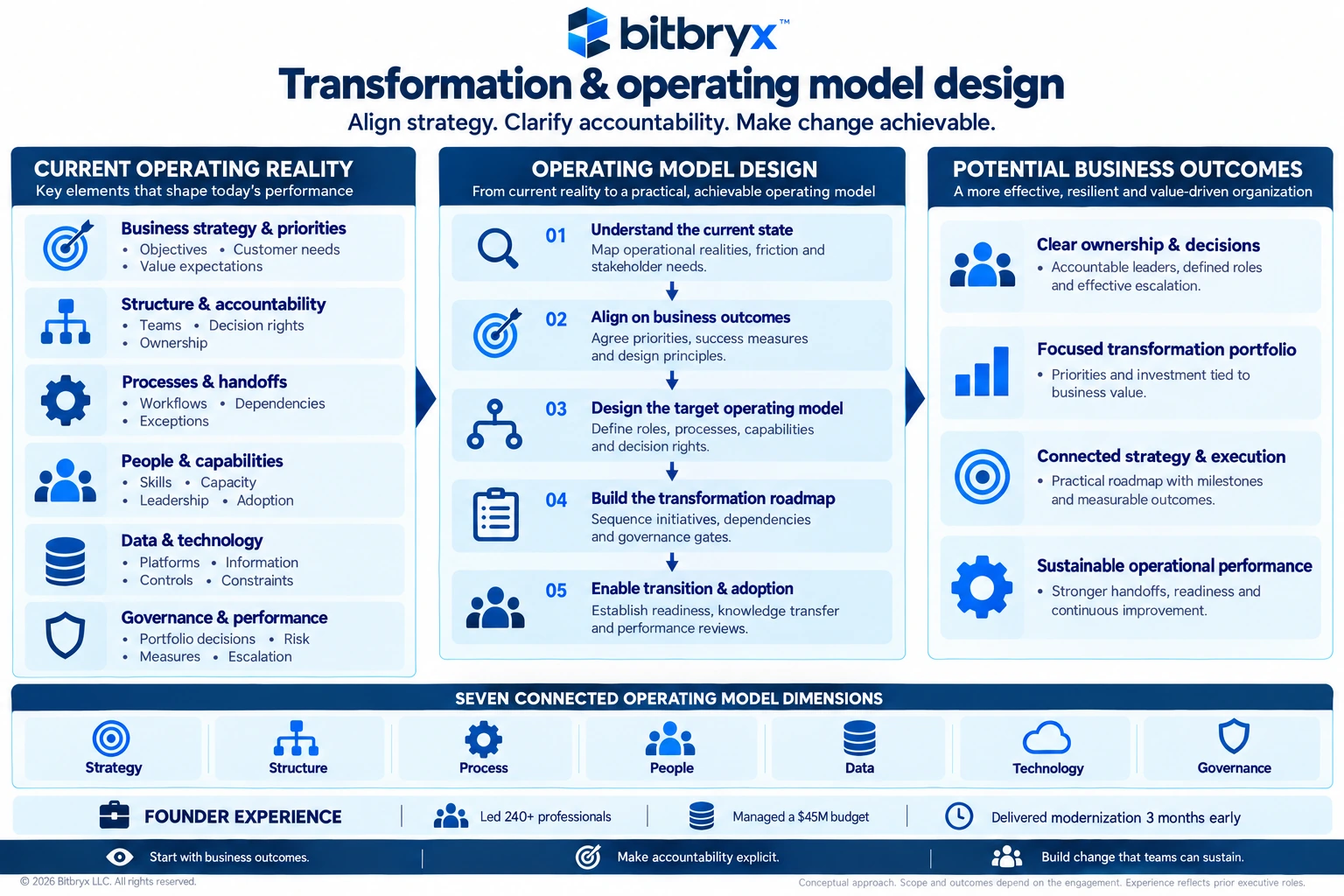
The approach draws on prior executive leadership of 240+ professionals and a $45M technology budget, including modernization delivered three months early. It brings practical experience of stakeholder alignment, delivery governance and the operational responsibilities that remain after deployment.
Where we bring value
An operating model should make priorities, responsibilities and decisions clear enough for people to act on them.
Agree the business problem, intended outcomes, constraints and success measures so the transformation has a shared purpose.
Clarify accountabilities, decision rights, process handoffs, capability needs and governance across business, operations and technology.
Sequence initiatives and dependencies, establish readiness gates, and plan knowledge transfer, adoption and performance reviews.
What a scoped discovery can establish
Start with one business service, capability or cross-functional challenge. Make the current constraints visible and establish an agreed direction for change.
Engagement boundary: Bitbryx provides assessment, target operating model design, transformation planning and advisory/assurance within agreed scope. Execution remains with accountable client teams or delivery partners. Transition governance and readiness reviews can be separately scoped.
Start with a focused organizational challenge
Discuss the priorities, ownership gaps or cross-functional handoffs slowing progress—and what a workable future state needs to address.